Zusammenfassung unserer erfolgreichen Teilnahme am 9. HSA-Symposium in Patras
(dg) Unsere Teilnahme am 9th Symposium der Hellenic Society for Archaeometry (HSA) in Patras war ein herausragender Erfolg und hat unsere aktuellen Forschungsarbeiten international sichtbar gemacht. Die Veranstalter betonten in ihrem offiziellen Abschlussstatement nicht nur das außergewöhnlich hohe wissenschaftliche Niveau der Beiträge, sondern dankten ausdrücklich allen Teilnehmenden für ihren essenziellen Beitrag zum Gesamterfolg der Konferenz.
Im Rahmen des Symposiums stellten wir erstmals unsere OSL-Datierungsergebnisse sowie die ersten Resultate der naturwissenschaftlichen Untersuchungen zu den Mumien von Tenerife vor. Die Präsentationen stießen auf großes Interesse und führten zu intensiven, fachlich höchst wertvollen Diskussionen:
- Die OSL-Datierungen lieferten neue, gut nachvollziehbare chronologische Hinweise für unsere Untersuchungsobjekte und fanden breite Anerkennung innerhalb der Fachcommunity.
- Die C-14-Ergebnisse und bioanalytischen Befunde zur Mumie, insbesondere der Nachweis unterschiedlicher Individuen sowie die ersten chromatographischen Signale phytoaktiver Substanzen, wurden mit großer Aufmerksamkeit verfolgt und als bedeutende neue Forschungsansätze gewürdigt.
Insgesamt stellte Patras für unser Team einen wichtigen Meilenstein dar: Die Präsentationen bestätigten die Relevanz unserer Forschung, stärkten den internationalen Austausch und eröffneten neue Perspektiven für Kooperationen und künftige Publikationen. Wenn unsere Forschungen auf den Kanaren, Azoren, Kuba und Marokko abgeschlossen sind, werden wir eine neue Sichtweise der Trans-Atlantikarchäologie zwischen der Alten und Neuen Welt offenbaren.
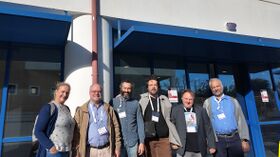
Das ABORA-Forschungsteam vor dem Kongresszentrum in Patras. Von re. Nach links: Dr. Michael Rappenglück (Archäoastronom), Dr. Dominique Görlitz (Experimentalarchäologie), Dr. Georgios Polymeris (OSL-Spezialist), Dr. Jorge S. Sánchez (OSL-Spezialist), Dr. Nuno Ribeiro (Azoren-Archäologie) und Frau Maria. In mehreren Vorträgen trugen wir unsere ersten Ergebnisse vor. //
The ABORA research team in front of the congress center in Patras. From right to left: Dr. Michael Rappenglück (archaeoastronomer), Dr. Dominique Görlitz (experimental archaeology), Dr. Georgios Polymeris (OSL specialist), Dr. Jorge S. Sánchez (OSL specialist), Dr. Nuno Ribeiro (Azores archaeology), and Maria. We presented our initial findings in several lectures.
Ich eröffnete unsere Vortragsreihe mit einem Vortrag über die kulturellen Beziehungen zwischen den Mittelmeerinseln und den Kanarischen Inseln. In meinem ersten Vortrag standen im Zentrum die frühe Seefahrt und die Verbreitung der Stufenpyramiden (Ziggurate) vom Orient bis zum Okzident. Die Recherche dokumentiert eine Vielzahl archäologischer und kulturelle Übereinstimmung zwischen den Mittelmeerinseln und der Kanaren. //
I opened our lecture tour with a talk on the cultural relations between the Mediterranean islands and the Canary Islands. My first lecture focused on early seafaring and the spread of stepped pyramids (ziggurats) from the Orient to the Occident. The research documents a multitude of archaeological and cultural similarities between the Mediterranean islands and the Canaries.
Dr. Rappenglück trug unsere Ergebnisse über die Ausrichtungen und mögliche Datierung der Stufenbauten auf Teneriffa vor. Unsere Messungen hatten ergeben, dass die beste Übereinstimmung mit den Sternbildern, der Position der Milchstraße und vor allem mit dem Aufstieg des Sirus (Sternbild Großer Hund) am Beginn des 3. Jahrtausends v. Chr. vorhanden ist. Michael kann seine Messungen auch mit Hilfe altkanarischer Legenden untermauern, was kein absoluter Beweis ist, aber Hinweise auf eine uralte Nutzung des Areals von Güímar liefert. //
Dr. Rappenglück presented our findings on the orientation and possible dating of the stepped structures on Tenerife. Our measurements had shown that the best correlation exists with the constellations, the position of the Milky Way, and especially with the rise of Sirius (Canis Major) at the beginning of the 3rd millennium BC. Michael was also able to support his measurements with the help of ancient Canarian legends, which is not absolute proof, but provides evidence of an ancient use of the Güímar area.
Georgios und Jorge (beide in der Mitte) hatten den nächsten Vortrag über den Stand der OSL-Datierung von den Stufenbauten in San Marcos und Santo Domingo/Teneriffa. Das wichtigste Ergebnis ist, dass wir von jedem Stein ein nutzbares OSL-Signal erhielten. Alle Signale streuen in der Stärke, was bedeutet, dass wir wahrscheinlich unterschiedliche Datierungen von einzelnen Bauphasen der Stufenpyramiden erhalten werden. Die Enddatierung erfolgt am Jahresende. //
Georgios and Jorge (both in the middle) gave the next presentation on the status of the OSL dating of the stepped pyramids in San Marcos and Santo Domingo/Tenerife. The most important result is that we obtained a usable OSL signal from every stone. All the signals vary in strength, which means we will likely obtain different dates for individual construction phases of the stepped pyramids. The final dating will take place at the end of the year.
Im letzten Vortrag präsentierten Jorge und ich die Ergebnisse der C14-Datierung von Georgios von der „Zusammengesetzten Mumie“ und der Liquid-Chromatographie. Die C14-Datierungen bestätigen die Hypothese der kanarischen Archäologen, dass die drei Körperteile von unterschiedlichen Menschen mit drei verschiedenen Altern haben (siehe Graphik). Das hohe Alter der Funde und die ersten Testungen der Chromatographie belegen, dass die angewandten Mumifikationstechniken eine hohe Fertigkeit besaßen. Mehr als 30 Substanzen konnten bei den ersten Tests nachgewiesen werden. Das ist ein sensationelles Ergebnis und lässt spannende Rückschlüsse auf die Fernhandelsbeziehungen der Guanchen zu! //
In the last presentation, Jorge and I presented the results of the C14 dating of Georgios' "composite mummy" and the liquid chromatography analysis. The C14 dating confirms the hypothesis of the Canarian archaeologists that the three body parts belong to different individuals of three different ages (see graph). The great age of the finds and the initial chromatography tests demonstrate the high level of skill employed in the mummification techniques. More than 30 substances were detected in the initial tests. This is a sensational result and allows for exciting conclusions about the Guanches' long-distance trade networks!
Nuno Ribeiro und ich präsentierten mit Hilfe eines Posters unsere sensationellen Ergebnisse der C14-Datierung von Holzkohleresten aus einer Stufenpyramide auf Pico Island/Azoren. Die Resultate haben ein Alter um 1100 n. Chr. Sie erbringen damit erstmals einen Beleg, dass diese Bauwerke lange vor der Wieder-Entdeckung durch die Portugiesen (um 1427 n. Chr.) schon gestanden haben müssen. Somit können wir sicher belegen, dass diese Stufenbauten keine Steinlesehaufen durch die frühen Europäer gewesen sein können. Wie alt sie wirklich sind, wollen wir 2026 durch weitere OSL-Datierungen aufklären. //
Nuno Ribeiro and I presented our sensational results from the C14 dating of charcoal remains from a step pyramid on Pico Island in the Azores using a poster. The results indicate an age of around 1100 AD. This provides the first evidence that these structures must have existed long before their rediscovery by the Portuguese (around 1427 AD). We can therefore definitively prove that these step pyramids could not have been mere piles of stones left by early Europeans. We plan to determine their true age in 2026 through further OSL dating.


Summary of Our Successful Participation in the 9th HSA Symposium in Patras
Our participation in the 9th Symposium of the Hellenic Society for Archaeometry (HSA) in Patras was a remarkable success and significantly increased the international visibility of our current research. In their official closing statement, the organizers emphasized not only the exceptionally high scientific standard of the contributions, but also expressed their sincere gratitude to all participants for their essential role in the overall success of the conference.
During the symposium, we presented for the first time our OSL dating results as well as the initial scientific findings from the investigations of the Tenerife mummy. These presentations attracted great interest and led to highly valuable professional discussions:
- The OSL datings provided new and comprehensible chronological insights into our research objects and received broad recognition within the scientific community.
- The C-14 results and bioanalytical findings on the mummy—particularly the evidence for different individuals and the first chromatographic signals of phytoactive substances—were followed with great attention and acknowledged as significant new research approaches.
Overall, the Patras symposium marked an important milestone for our team: the presentations confirmed the relevance of our research, strengthened international scientific exchange, and opened new perspectives for future collaborations and publications. When our research in the Canary Islands, Azores, Cuba and Morocco is completed, we will reveal a new perspective on trans-Atlantic archaeology between the Old and New Worlds.
